




What we miss from holidays is rarely the destination — it's the slower morning, the unfamiliar scent, the fresh sheets, the soft view. This guide breaks down how to make your home feel like a holiday through the senses, with a few cues borrowed from hotels like Aman, Six Senses, Hotel Esencia and Babylonstoren — none of which require a flight or a renovation to copy.

Think about the holiday you remember most clearly. Try to picture the actual destination. Now try to picture the smaller things — the sheets in the hotel room. The smell when you opened the bathroom door. The light through the window in the morning. The view of something green or blue. The small ritual you only do on holiday (coffee somewhere new, a long bath, a walk before dinner).
If you are like most people, the second list is sharper than the first.
The interesting consequence is that almost none of that second list depends on geography. It depends on the senses. Which means the feeling of a retreat can be brought into a flat you have lived in for years, on a Tuesday, for the cost of a candle and the willingness to turn off an overhead light.
Below: a plain-English guide to making your home feel like a holiday, plus a few field notes from the hotels and designers who have been quietly perfecting "restorative" for decades.
In this article
- What we really miss from holidays
- A retreat is a sensory experience
- How to start with scent
- How to use light to mark the shift into rest
- How to make the bedroom feel like a place you return to
- How to make the bathroom feel more restorative
- How to add nature where the eye naturally rests
- Why ritual matters more than decor
- Bottom line: the retreat is in the senses
What we really miss from holidays
It is rarely the place. It is usually:
- Slower mornings.
- Fresh, properly-changed sheets.
- A scent that is not the scent of your normal life.
- Softer, lower evening light.
- A view of something growing or moving.
- Less of your usual clutter.
- A small ritual the day asks of you (coffee, a swim, a walk, an evening drink).
Almost every entry on this list is a sensory variable — touch, smell, sight, sound — and almost every entry can be replicated at home. The hospitality designers behind hotels like Aman (the luxury chain whose interiors set the contemporary "retreat" template), Six Senses (a wellness-focused hotel group with a deliberate sensory design philosophy) and Babylonstoren (the South African farm-hotel that defined biophilic hospitality) all design around exactly this list. None of them rely on the destination to do the work for them. The room has to do it.
A retreat is a sensory experience
Research on the multi-sensory experience design of interior spaces identifies lighting, colour, spatial form, sound, material and scent as the six factors that together shape a room's emotional ambience. Restorative spaces — the ones we describe with words like "retreat" and "sanctuary" — are simply rooms where all six are working together rather than against each other.
The British designer Ilse Crawford — the designer who shaped the original Soho House interiors and now runs Studioilse — puts it more plainly. In her widely-shared TED talk, she frames the entire idea of wellness-led design around the senses:
"I'm a designer. I'm interested in well-being, and I think that we can't talk about well-being without thinking about the senses." — Ilse Crawford, TED 2014 — watch here
If you take this seriously, the move is not "redecorate." It is "design what the body receives."
How to start with scent
Scent is the single fastest way to make a room feel like somewhere else. A 2025 study on sensory design with scent notes that ambient indoor smells meaningfully affect mood, behaviour and wellbeing — yet scent is the most consistently overlooked layer of interior design.
Holiday-feeling scents tend to share a few notes:
- Citrus for freshness.
- Lavender for calm.
- Wood notes — cedar, sandalwood — for grounding.
- Herbal scents for a Mediterranean feeling: rosemary, eucalyptus, fig, pine.

Try this tonightChoose one scent for one room. Diffuse it for two hours. Notice whether you spend more time in that room than usual. (Most people do.) If it sticks, use it only in that room — never on your clothes, never elsewhere in the house. Scent works as a holiday cue exactly because it is location-specific.
How to use light to mark the shift into rest
One of the things we love about hotel rooms — even modest ones — is that the lighting is considered. Daylight in the morning, low warm light in the evening, a bedside lamp instead of an overhead. The Blume, Garbazza and Spitschan review on light and human circadian rhythms describes this matching of light to time of day as one of the most powerful environmental cues the body has. Oxford circadian neuroscientist Russell Foster, whose 2022 book Life Time brought this research to a general audience, says the same thing in interview after interview: light is the dominant signal our biology runs on.
For an at-home retreat:
- Pull the curtains back fully in the morning.
- Switch to lamps after sunset, not the overhead.
- Add candlelight or soft diffused light to mark the evening.
- Keep the harshest bulbs out of the bedroom entirely.
How to make the bedroom feel like a place you return to
The bedroom is where most of the retreat actually happens. Holiday bedrooms tend to share a few qualities: better bedding than you usually allow yourself, soft bedside lighting, calmer colours, a tidy surface, and no harsh light before sleep.
Practical, immediate changes:
- Upgrade bedding and bath linen — the single biggest lever.
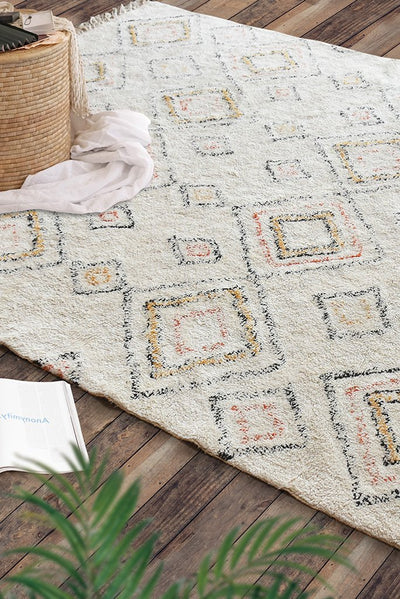
- A small rug beside the bed, for the first step in the morning.
- Calmer wall colours and fewer objects on the bedside table.
- A scent ritual at night — a drop of essential oil on a pillow, or a candle blown out before sleep.

How to make the bathroom feel more restorative
The bathroom is often the most overlooked room in a flat, and the one most ready to be turned into a retreat. The changes are small:
- Better, softer towels.
- A natural scent diffusing quietly.
- Warm rather than cool overhead lighting (or a small lamp on the counter, hotel-style).
- Stone, ceramic, wood or woven baskets to soften hard surfaces.
- One plant or one preserved nature element.
- A small stool or tray for ritual — a cup of tea, a book, oil after a shower.
This is also the move that hotels like Hotel Esencia in Tulum and Babylonstoren in South Africa make consistently — bathrooms designed less like sanitary spaces and more like rooms you could spend an hour in.
How to add nature where the eye naturally rests
In any room, identify the spot where the eye lands first when you sit down — the wall opposite the sofa, the view from the bed, the corner of the dining area. That is the spot to give to nature.
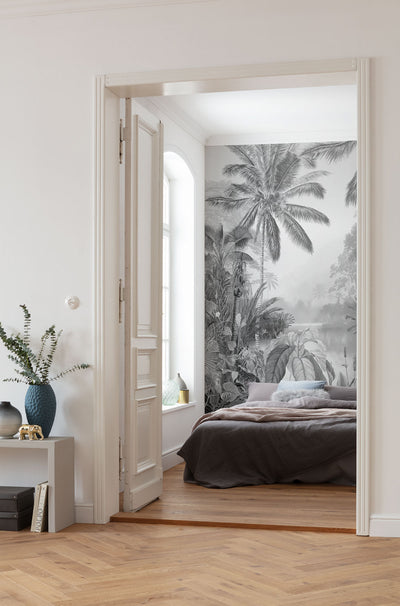
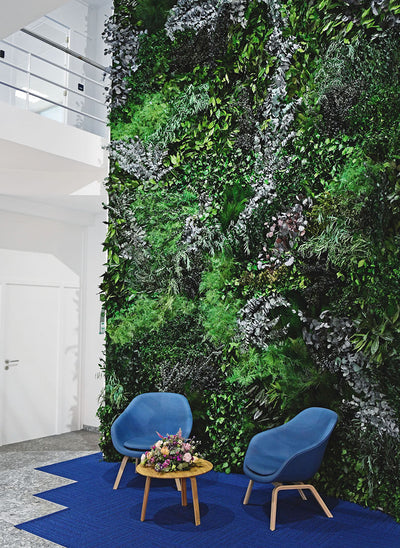
A panel of botanical mural wallpaper, a plant or moss wall, a canvas of a forest or shoreline — none of it is decorative noise. Each one is an anchor that quietly pulls the nervous system a little closer to ease.


Why ritual matters more than decor
This is the most important distinction in the article. A "holiday at home" is not about turning a flat into a beach house. It is about giving yourself one or two small, repeatable rituals that mark the day as different from work mode.
The American designer and food writer Athena Calderone — founder of EyeSwoon and author of Live Beautiful — has made a career arguing that the difference between a styled house and a home you want to live in is exactly this layer: small daily rituals that make the room useful in your real life.
Examples that work:
- Morning coffee at a specific window.
- An evening lamp ritual — one specific lamp you turn on after dinner.
- Scent after a shower.
- Reading in one chair, only.
- Stretching on a rug before bed.
- Music during dinner.
Bottom line: the retreat is in the senses
A home retreat is not a renovation. It is a way of paying closer attention to the senses you usually leave on autopilot — and trusting that the body knows the difference. Designers like Crawford, Calderone, Heuman and the teams behind Aman and Six Senses have made entire careers out of essentially this idea: rooms exist to support what happens inside them.
You do not need a flight to be on holiday for an evening. You need a candle, a lower lamp, a better sheet, a softer towel, and the willingness to give yourself one ritual the day did not already ask for.
Explore our natural scents, bed and bath linen, soft lighting, plant wall art and natural textiles. Or read more about our approach to designing for the senses.




Leave a comment