




Focus is not only a personal discipline — it is also environmental. The right home office quietly reduces friction; the wrong one drains attention before you have even sat down. This guide walks through how to design a home office that supports concentration without making your flat feel like a corporate floor, with research from the biophilic design literature and references from contemporary designers like Studioilse, Norm Architects and Pierre Yovanovitch.

If you have ever blamed yourself for being "bad at focusing" in your home office, it is worth checking the room first. Most home offices were not chosen — they were inherited. The desk went under the only window that worked. The lamp came from a previous flat. The chair was a 2020 panic purchase that has never been re-evaluated. The fact that focus is harder there than it has any right to be is not, usually, a willpower problem. It is a layout problem, a lighting problem and an acoustics problem.
The good news: the research on this is unusually consistent. Plants help. Natural materials help. Layered lighting helps. Soft surfaces help. None of it requires moving house.
Below: how to design a home office that helps you focus, with the field notes contemporary designers and biophilic-design researchers actually use.
In this article
- Why your home office might be working against you
- How does lighting affect concentration?
- Do plants and nature-inspired design really help?
- How do I reduce visual clutter?
- How does texture quietly help focus?
- What colors are best for a home office?
- How do I separate work from home life in the same space?
- Home office checklist
Why your home office might be working against you
The most common reasons concentration is harder at home are not motivational. They are environmental:
- Poor lighting — too dim, too cold, too glaring, or all coming from one overhead.
- Visual clutter on the desk and surrounding shelves.
- No natural elements within sight.
- A chair and desk arrangement that fights the body.
- Background noise the room cannot absorb.
- No clear ritual that says "work begins now" or "work is over."
- Working from the wrong room — usually the bedroom or sofa.
Fix two or three of these and focus often returns on its own.
How does lighting affect concentration?
Light is the first and most important variable. The Blume, Garbazza and Spitschan review on light and circadian rhythms describes light as the body's primary timekeeper — alertness, mood and sleep all hinge on getting the right kind of light at the right time of day.
For a home office:
- Maximise daylight during the day. Place the desk close to a window if possible.
- Add a dedicated task light for clarity — pointed at the work surface, not your face.
- Avoid glare on screens.
- Switch to warmer light later in the day.
- Keep work light separate from evening rest light. The signal that the day has ended is partly a lighting signal.

Do plants and nature-inspired design really help?
Yes — and the evidence is unusually direct. The Human Spaces global report surveyed 7,600 office workers across 16 countries and found that those with natural elements in their workspace reported 15% higher wellbeing, 6% higher productivity and 15% higher creativity than those without. The Nature in the Office systematic review reaches the same conclusion: natural elements indoors — particularly wood and visible greenery — measurably support the stress response.
This is the underlying brief behind biophilic workplaces like Apple Park in Cupertino (Foster + Partners' contemporary biophilic headquarters), Amsterdam's Edge tower (one of the most-studied biophilic office buildings in Europe) and Heatherwick Studio's 1000 Trees in Shanghai. None of those budgets apply at home — but the principles scale all the way down to a desk corner.
Practical, low-cost moves:
- One or two living plants.
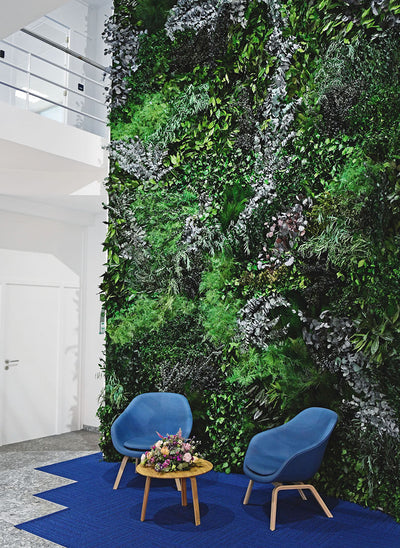
- Preserved moss panels or a piece of plant wall art at eye level.
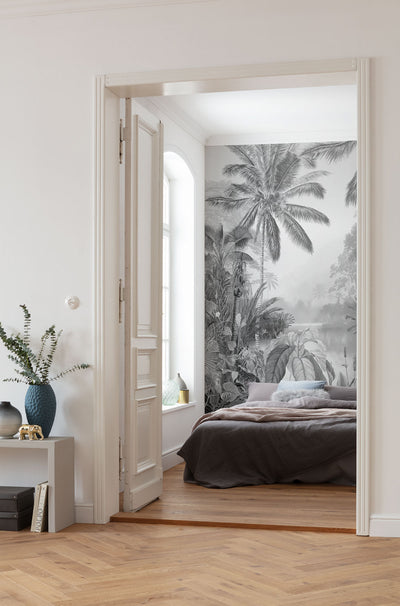
- A panel of botanical wallpaper behind the desk.
- A nature-inspired canvas print opposite the chair.
- Wood grain on the desk, shelves or chair.
- A view of something outside, if possible.
- Organic shapes — a curved mirror, a soft-edged vase.

How do I reduce visual clutter?
Visual clutter is one of the most underestimated drains on attention. Every object in the line of sight is a tiny cognitive load. The fix is not minimalism for its own sake — it is choosing fewer, better things:
- Clear the desk surface daily.
- Hide or bundle cables.
- Use closed storage rather than open shelving for paperwork.
- Keep one calming focal point — a plant, a print, a single object.
- Resist the urge to decorate around the work.
This is essentially the principle behind Vincent Van Duysen's three-word brief — calm, sensorial, modest — applied to a workspace. The Belgian designer's own Antwerp studio has been photographed dozens of times for Architectural Digest and Wallpaper; what every photograph has in common is how little is in it.
How does texture quietly help focus?
Hard rooms ring. Soft rooms absorb. A workspace lined with hard surfaces — wood floor, plaster walls, glass desk — will feel acoustically tiring within an hour. Add:
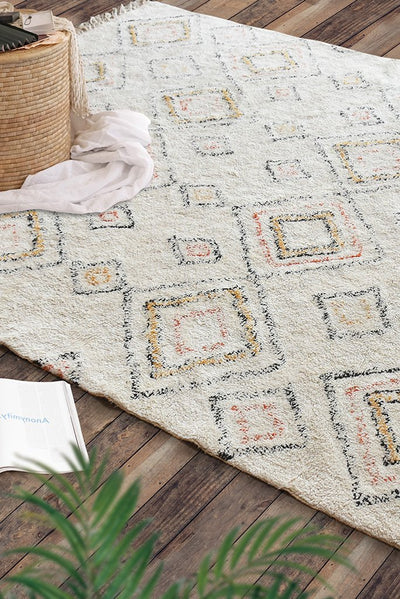
- A rug underfoot.
- Curtains or fabric blinds.
- Upholstery on the chair.
- A cork or fabric pinboard.
- Plant or moss wall art — which doubles as an acoustic softener.
- Natural-fibre baskets for storage.

What colors are best for a home office?
The University of Bologna study on interior colour and psychological functioning found that environmental colour influences mood and even study facilitation over time, with blue and green tones particularly associated with calmer states. For focus work, the colours that consistently support calm attention are quieter than people expect:
- Soft green
- Muted blue
- Warm white
- Clay
- Sand
- Taupe
- Light wood
- Olive
Avoid high-contrast, chaotic combinations. The room should fade slightly while you work.

How do I separate work from home life in the same space?
Home offices need boundaries the building cannot provide. A ritual is the cheapest boundary you can build:
- Turn on the task lamp to begin.
- Clear the desk at the end.
- Change the lighting from cool/bright to warm/low when you stop.
- Use a scent only for focus, or only for rest, never both.
- Close the laptop and cover the workspace with a cloth or board if it sits in a shared room.
"Focus is not only a personal discipline. It is also environmental — shaped by light, visual noise, natural cues, and how demanding the room feels to the nervous system." — A useful frame, distilled from the biophilic workplace literature.
Home office checklist
- Good task light, no glare.
- One nature focal point within sight.
- Clear desk surface.
- Soft acoustics underfoot and on the walls.
- Comfortable, supportive chair.
- Closed storage for paperwork.
- A warm evening light to mark the end of work.
Hit five out of seven and the room starts to do most of the work for you. The thing you have been calling "focus" turns out to be partly about a lamp, a plant and a clear desk.
Explore our desk lamps and wall lights, plant wall art, botanical wallpaper, storage baskets and natural wood decor. Or read our piece on designing indoor spaces for mental clarity.




Leave a comment