




We usually approach "bringing the outdoors in" the exact same way: we buy a potted Monstera, place it in an empty corner, and hope for the best. It’s a wonderful start. But if you’ve ever sat on your sofa next to that plant and still felt a lingering sense of anxiety, brain fog, or exhaustion, you aren't alone.
While a single plant is beautiful, it rarely provides the deep, restorative psychological shift our bodies actually need. In a world that is increasingly digital, fast-paced, and indoor-bound, our nervous systems are working overtime just to process the artificial environments we live in.
At Forest Homes, we’ve always believed that how interior design affects mental health is not just a theory, it is a daily physical reality. Our brains did not evolve to live in square, drywall boxes filled with synthetic lighting. We are still biologically hardwired for the complex, sensory-rich environments of the natural world.
To achieve true mental clarity at home, we need to move beyond simple "decorating" and toward immersive biophilic design. This means creating an environment that engages all your senses—visual, tactile, and acoustic—to mimic the complexity of a living ecosystem.
Here is the science behind why your current space might be draining your energy, and how to build an immersive indoor ecosystem that actually helps you breathe, think, and rest.
1. Attention restoration theory (ART): Giving your brain breaks
To understand why a single potted plant isn't enough, we first have to look at how human attention works. In our modern lives, we rely heavily on something psychologists call directed attention.
Directed attention is the intense, effortful focus required to answer emails, navigate heavy traffic, or stare at a spreadsheet. The problem? It is a finite resource. When you drain your directed attention, you experience mental fatigue, irritability, and a severe drop in problem-solving ability. You literally run out of the mental fuel required to stay calm.
Nature offers the biological antidote to this fatigue through a concept called soft fascination.

Environmental psychologists Rachel and Stephen Kaplan developed attention restoration theory (ART) to explain this phenomenon. When you look at a natural scene, like a forest canopy swaying in the wind or the organic grain of a piece of wood, your brain doesn't have to "work" to process the information. The visual input is gently engaging, capturing your attention effortlessly. This state of "soft fascination" allows the part of your brain responsible for directed attention to power down and recharge.
How to build this into your indoor space: If your living room is filled with harsh, geometric furniture and solid, flat colors, you are missing opportunities for soft fascination. You can introduce visual rest by swapping synthetic, flat surfaces for organic textures.
-
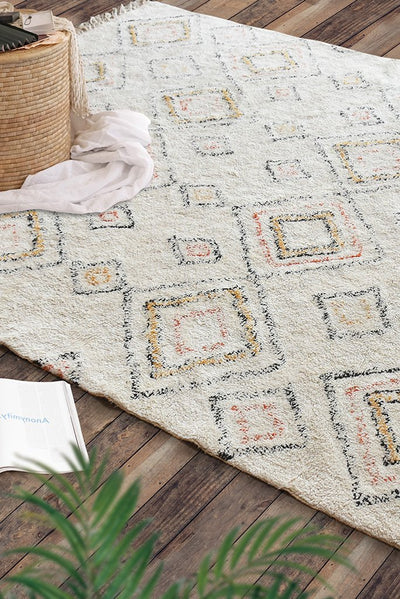
Tactile anchors: Look at pieces from our Earthy & Neutral Collection, like our Paul Wooden Stool or our Alois NZ Wool Rug. The irregular, sweeping lines of natural wood grain or hand-spun fibers provide your eyes with a place to rest, triggering that restorative brain state without you even realizing it.
2. Scale and the "prospect-refuge" effect
One of the most powerful concepts in biophilic design is the prospect-refuge theory.
Coined by geographer Jay Appleton, this theory explains that humans feel most relaxed when two conditions are met: we have a clear, unobstructed view of our surroundings (prospect), and we feel safely enclosed or protected from behind (refuge). It’s an evolutionary survival mechanism. On the savanna, being able to see far away while hiding under a canopy meant you were safe from predators. Today, it’s the reason we instinctively prefer sitting in a restaurant booth rather than a table in the middle of the room.
In a standard modern home, we often feel "boxed in" because our rooms provide refuge, but absolutely no prospect. We stare at blank walls that stop our visual field abruptly, which can trigger a subtle feeling of confinement.

How to build this into your indoor space: To create an immersive ecosystem, you must change the scale of the nature you are viewing. A small desk plant does not provide prospect.
-
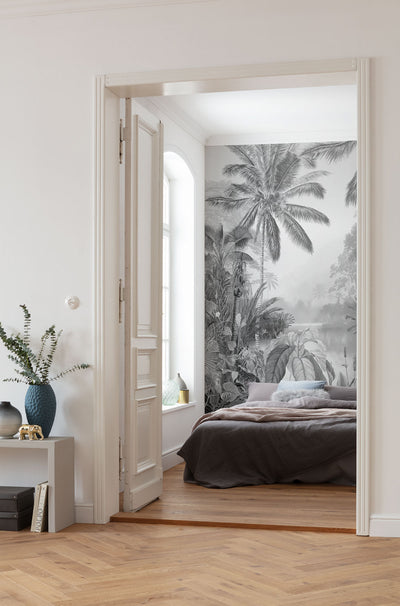
Opening the visual horizon: By applying a large-scale mural, you trick the brain into perceiving depth. Instead of a flat wall, applying the Misty Crowns Mural Wallpaper or a lush Climber Canopy Mural Wallpaper creates a visual horizon. It pushes the boundaries of the room outward, reducing the feeling of confinement and lowering stress hormones.
-
Creating the canopy: To fulfill the "refuge" aspect, you can lower the visual ceiling over a seating area using lighting. Hanging a wide, umbrella-like fixture, such as the large version of the Bromo Pyramidal Bamboo Pendant Light, over a reading chair creates a safe, comforting "canopy" effect right in your own living room.
3. Acoustic ecology: Lowering the "noise floor"
When people think of designing a nature-inspired home, they almost exclusively think about what the room looks like. But what the room sounds like is just as critical.
Modern homes—especially open-concept ones—are often "acoustically bright." They are filled with hard, reflective surfaces like glass windows, concrete floors, and bare drywall. These materials bounce sound waves around the room, creating echoes and raising the overall "noise floor."
Even if you don't consciously notice the hum of your refrigerator, the echo of your dog walking across the floor, or the traffic outside, your nervous system does. A constant, high noise floor keeps your body in a state of micro-alertness, silently spiking cortisol levels.

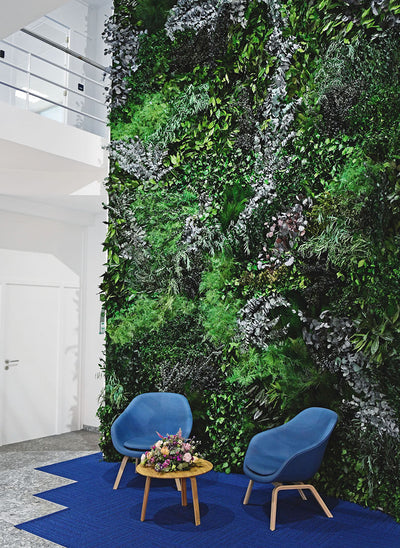
How to build this into your indoor space: In the wild, a mature forest is eerily quiet. This is because the complex, porous structure of leaves, bark, and moss breaks up and absorbs sound waves. You can replicate this acoustic ecology indoors using preserved plant, moss and cork pieces.
-
Natural soundproofing: Moss is an incredible, natural acoustic dampener. By installing Hexagon Preserved Moss Wall Tiles in a home office, or placing a series of Cork Bark Acoustic Panels in a dining room, you are essentially installing a natural "silencer."
-
Passive wellness: These pieces absorb the high-frequency "chatter" of a room. Because the moss in our collection is naturally preserved, it maintains its soft, sponge-like texture for years, providing the acoustic and visual benefits of a living wall without the need for complex watering systems.
4. Fractals: Nature’s mathematical language
Take a close look at a fern leaf, the branching of a river, or the veins in a piece of marble. What you are looking at is a fractal.
Fractals are self-similar patterns that repeat at different scales. They are the mathematical language of the natural world. Groundbreaking research by physicist Richard Taylor has shown that the human eye is specifically "tuned" to process a certain range of fractal complexity (known as a D-value between 1.3 and 1.5).
When our eyes sweep across these specific fractal patterns, our brains naturally produce alpha waves. Alpha waves are the exact same brain waves we produce during deep meditation or right before we fall asleep.
The problem with modern interior design is that it is often visually impoverished. Man-made objects are generally non-fractal; they feature flat, straight, predictable lines. Surrounding yourself with non-fractal geometry requires more cognitive effort to process, leading to visual fatigue.

How to build this into your indoor space: You must reintroduce nature's math into your sightlines.
-
Fractal lighting and shadows: You don't just have to rely on patterns on a wall. Lighting can create fractals, too. A piece like the Iguazu Pyramidal Jute Pendant Light introduces complex, repeating geometry.
-
Organic decor: Small touches matter. Swapping out a plain cutting board for an olive wood cutting borad such as the Benny Board introduces those intricate, repeating grain patterns that act as a visual massage for your brain.
5. Circadian entrainment and material honesty
The final, and perhaps most overlooked, layer of an immersive indoor space is material honesty.
Material Honesty is a design principle stating that materials should be used for their true qualities and not disguised as something else. Think of vinyl flooring manufactured to look like oak, or plastic molded to look like stone. While they might fool the eye from a distance, our brains are incredibly adept at sensing "fakeness." When we are surrounded by artificial materials masquerading as natural ones, it creates a subtle sense of disconnect or "un-homeliness."
Using honest, natural materials like real rattan, genuine linen, solid stone, and untreated wood, it creates a sensory connection to the physical world. This is directly tied to Circadian entrainment, which is the alignment of your body's internal clock with the external rhythms of the sun.

How to build this into your indoor space: Synthetic materials bounce light in harsh, unnatural ways. Natural materials filter and soften light, helping to regulate your sleep-wake cycle.
-
Filtering the sun: A fixture like our Mushroom Bamboo Floor Light or the Tube Mouth-blown Glass Pendant Light does something remarkable in the evening. As the light passes through the natural fibers or tinted glass, it mimics the warm, low-angle, amber light of a setting sun.
-
Triggering rest: This specific color temperature tells your suprachiasmatic nucleus (the part of your brain that controls your sleep cycle) that the day is over. It triggers the release of melatonin, helping you transition out of the high-alert state of the workday and into a restorative, deep sleep.
The long-term return on wellbeing
In the home decor world, we spend a lot of time talking about how to make a space look beautiful for guests. But true biophilic design is deeply personal. It’s not about how the room looks in a photograph; it is entirely about how the room feels to the person living inside it.
When you build an immersive indoor space, you are making an investment in your cognitive longevity. By actively reducing the load on your directed attention with soft textures, dampening acoustic stress with preserved moss, and providing the fractal patterns your brain naturally craves, you are creating a home that actually gives you energy instead of taking it away.
You aren't just filling empty corners. You are building spaces where your nervous system can finally exhale.
Explore the full collection of nature-rooted design at Forest Homes Store and find the pieces that will complete your home's ecosystem today.




Leave a comment