




The rooms we remember are not the most styled — they are the ones we couldn't quite leave. This guide walks through how to design a cozy living room in plain language: how to layer your lighting, what kind of fabrics actually make a sofa feel inviting, how scent and sound quietly change the mood, and how to arrange a room so people actually talk to each other. With a few cues borrowed from the designers and hotels that have been quietly perfecting all of this for years.

You probably know the feeling, even if you have never thought of it as a design feeling. You go to a friend's flat for "just one drink." Two hours later, no one has moved. The conversation has slowed down, someone has refilled everyone's glass without asking, the lamps are doing all the work the ceiling light used to do, and you are quietly aware that you do not want to leave.
That is a cozy living room doing its job.
It almost never happens in the perfectly styled rooms. It happens in the lived-in ones. In rooms designed, knowingly or not, around the senses — light, texture, scent, sound, the way the seats are placed. The good news is that none of this requires a renovation budget, a degree in design, or even strong opinions about furniture. It mostly requires noticing which small things make a room hold people, and doing more of those.
Below: a plain-English guide to designing a cozy living room, with a few field notes from the designers and hotels who have been quietly perfecting all of this for years.
In this article
- Why some rooms make people want to leave quickly
- What makes a living room feel intimate and welcoming
- How should I use lighting in the evening?
- How can texture, scent and sound shape the atmosphere?
- How do I design for real connection, not just decoration?
- What products help a living room feel cozy and inviting?
- The long-evening formula
- Bottom line: Rooms that hold us
Why some rooms make people want to leave quickly
Before designing a cozy living room, it helps to notice what makes a room feel uncozy. The pattern shows up everywhere. Think of any waiting room you have ever sat in. The lights are too bright. They come from the ceiling. The chairs face the wrong way. There is nothing soft to lean on. The room sounds slightly echoey. You feel, quietly, like you should not stay.
Most living rooms have at least two of those problems. Not because their owners do not care, but because most living rooms inherit lighting and layout choices that nobody really chose — the ceiling light came with the flat; the sofa got placed wherever it fit. Cozy living room design is almost always a project of noticing first, then quietly editing.
If you want a more elegant version of that idea, the Belgian interior designer Vincent Van Duysen — whose work you have probably seen if you have ever flipped through a Molteni furniture catalogue or stayed at a high-end European hotel — describes his approach in three words: calm, sensorial, modest. The plain translation: design that helps you exhale.

What makes a living room feel intimate and welcoming
If you trace what intimate rooms have in common, the list is surprisingly short. Low, warm light. Comfortable seating arranged so people face each other. Soft textures within reach. Warm materials underfoot. A faint scent that does not announce itself. Sound that absorbs rather than echoes. And — this matters more than it sounds — objects with stories rather than props.
None of these are mysterious. They are the same six things that show up in a 2025 research review on multi-sensory interior design, which identifies lighting, colour, spatial form, sound, material and scent as the factors that together build a room's emotional atmosphere. In other words: the senses you sometimes forget about (smell, hearing, touch) do more of the work than the senses you photograph for Instagram.
The British designer Ilse Crawford makes this point as well as anyone. If the name does not ring a bell: Crawford is the designer who shaped the original Soho House interiors — the soft, lived-in look that every wellness-y hotel and members' club has copied since. Her studio, Studioilse, designs explicitly for "well-being." In her widely-shared TED talk A Designer's Search for the Human in Everything, she opens with a line worth taping above the sofa:
"I'm a designer. I'm interested in well-being, and I think that we can't talk about well-being without thinking about the senses."— Ilse Crawford, TED 2014 — watch here
That is, in plain terms, the brief for a cozy living room: design for the body before the camera.
How should I use lighting in the evening?
If you change one thing in your living room this week, change the lighting. It is the single most important variable, and the one most people get wrong without realising.
Here is the short version of why: cool, bright bulbs send a "morning" signal to your body, even at 9pm. Warm, low light sends an "evening" signal. The Oxford circadian neuroscientist Russell Foster — author of the 2022 book Life Time, written for general readers — has been clear in interview after interview that light is the most powerful environmental cue our biology runs on. The scientific literature agrees: a large review on light, circadian rhythms, sleep and mood describes evening light as one of the strongest signals for moving the body out of "alert" mode.
That is why every well-designed hotel room in the world is on dimmers, and almost no domestic living room is.
Try this tonight: Turn off the ceiling light. Turn on two or three lamps at different heights (a table lamp, a floor lamp, a small reading light). Notice the difference within five minutes. If your lamps have cool-white bulbs in them, swap one for a warm-white bulb — that single swap usually changes how the room feels more than a new cushion would.

For a cozy living room, treat evening light as its own layer of design:
- Use lamps at different heights — table, floor, wall — instead of one ceiling source.
- Add wall lights for a softer perimeter glow.
- Use a low pendant directly over the dining table (or, if you don't have one, put a tall floor lamp behind the sofa).
- Choose warm bulbs. The number you want is around 2200–2700K — it should say on the box.
- If you have a dimmer, use it. If you don't, install one — it costs less than a takeaway and is genuinely the highest-return upgrade in a living room.
Create pools of light, not flat illumination
If you remember nothing else about lighting a cozy living room, remember this: instead of lighting the whole room, light four places in it.
- One near the sofa.
- One over or near the dining table.
- One accent light near a wall, artwork or plant.
- One soft bedside or reading light.
Three to five pools of warm light at human height almost always feel better than a single overhead. It is the principle behind every interior at Norm Architects (a Copenhagen studio whose quiet, warm-minimal Scandinavian work shows up in basically every interiors magazine), every Aman lobby, and the dining rooms at Hotel Esencia in Tulum. None of them are over-lit. All of them feel impossible to leave.
How can texture, scent and sound shape the atmosphere?
A cozy living room is never only visual. The body reads a room through every sense at once, and the senses we tend to overlook — touch, smell, hearing — often do more of the emotional work than sight.
Texture: the part of the room your body notices first
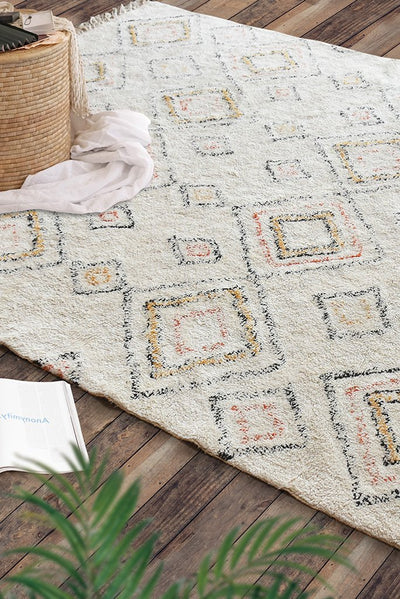
Before your eyes register what is in a room, your skin does. A rug underfoot makes people slow down. A cushion that pushes back invites leaning in. A throw, even in summer, in lightweight wool or linen, communicates "you can stay." The materials we touch every day matter more than the ones we look at — which is essentially the thesis of Beata Heuman's 2021 book Every Room Should Sing. (Heuman is a Swedish-born London designer whose own west-London flat is frequently photographed in interiors magazines — it is essentially a sustained argument for natural fibre, hand-finished ceramic and the kind of object you keep for thirty years.)
The takeaway for any living room: pick natural fibres for the things you actually touch. Wool, linen, cotton, jute on a rug, ceramic in a lamp base. The room will read as warmer almost instantly.

Scent as a memory cue
Scent is the most underused element in interior design and one of the most emotionally direct. A 2025 study on sensory design with scent found that ambient indoor smells meaningfully affect mood, behaviour and wellbeing — yet scent is rarely treated as part of how a room "works."
You do not need a complicated set-up. A handcrafted candle in a quiet corner. Fresh herbs on the dining table — rosemary, basil, mint. Essential oils diffused on low. In summer: citrus, fig, lavender, green notes. In autumn: cedar, amber, woodsmoke.
This is also where the Danish concept of hygge earns its now-overused reputation. Stripped of the Instagram patina, hygge just means: candles, soft chairs, dim light, scent, the smell of food cooking, a few people you actually like, and the deliberate absence of distraction. You do not need to call it anything fancy to do it.

Sound as the layer no one notices until it's wrong
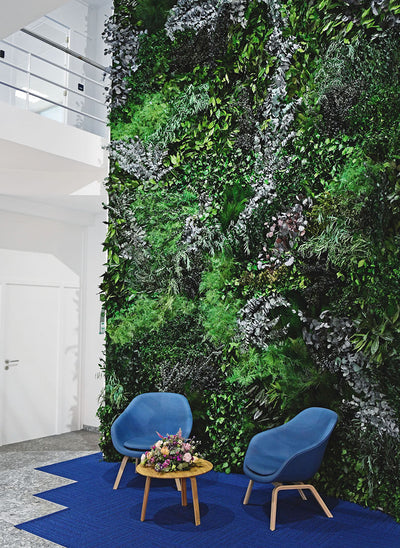
Hard rooms ring. Soft rooms absorb. If you have ever sat in a beautiful flat with concrete floors and high ceilings and felt subtly tired after an hour, that is acoustics. Rugs, curtains, upholstered seating and even a plant wall quietly absorb the upper frequencies that make a room feel exposed. Most homes have one or two too few of these. Adding a rug under the sofa is usually the cheapest fix.

How do I design for real connection, not just decoration?
Here is where most aspirational living rooms quietly fail. A room that looks like a showroom rarely feels like a home. The fix is small but unmistakable.
- Arrange seating so people face each other, not the television.
- Leave space on side tables for a glass, a book, a plate of olives. (Empty surfaces tell guests "don't put anything here." Slightly lived-in ones tell them "this is yours too.")
- Choose objects that have a story — something handmade, inherited, brought back from a trip you remember. They are almost always the things guests pick up.
- Resist the urge to over-style. A perfectly styled room is harder to relax in than a slightly lived-in one.

One of the clearest articulators of this is Athena Calderone, an American food writer and designer (you might know her Instagram, EyeSwoon) who has built one of the most-followed design audiences online around essentially this idea: that the best rooms look like they are inhabited, not waiting for someone to arrive. In her book Live Beautiful, she calls her own Brooklyn home an exercise in "imperfect beauty." The phrase sounds Instagram-friendly, but the discipline behind it is real — edit, but do not over-edit.
The other useful frame is the slow-design idea that brands like Patagonia have made mainstream in clothing — fewer, better, longer-lasting things. The same logic applies to interiors. The most truly cozy living rooms tend to contain fewer pieces than people expect; they are simply pieces that have been chosen well and lived with for a long time. You almost never need more stuff. You usually need better placement of what you already have.
Try this on a Sunday afternoon: Walk into your living room as if you were a guest who had never been there before. Where would you put your drink? Where would you sit if you had brought a book? If both answers are "I'd stand awkwardly until someone moved something," you have a layout problem, not a furniture problem. Move two pieces of seating slightly closer together. Put a side table within arm's reach of each one. That's the whole project.
What products help a living room feel cozy and inviting?
These are the categories that do the heaviest lifting when you are designing a cozy living room from scratch — or, more often, quietly upgrading the one you already have:
- Wall lights, pendant lights and table lamps for the layered glow that defines a cozy living room.
- Rugs, cushions and throws in natural fibres — wool, linen, cotton, jute.
- Natural scents and essential oils for the unforced, atmospheric layer.
- Plant wall art for an organic focal point that also softens the room's acoustics.
- Ceramic and natural wood decor for objects with hand and story.
- Seating that genuinely invites a second hour at the table.
The long-evening formula
If you remember nothing else from this guide, remember this:
Warm light + soft ground + natural texture + quiet scent + comfortable seating = a cozy living room people linger in.
That formula has been quietly true of every truly welcoming space we have ever known — from Soho House's original drawing rooms to Aman Tokyo's lantern-lit lobby, to the candlelit terrace at Le Sirenuse, to your friend's slightly imperfect flat where everyone ended up staying until midnight. It is also one of the few design formulas that gets cheaper the more honestly you follow it — because it rewards what you already have over what you would have to buy.
Bottom line: rooms that hold us
A cozy living room is not a renovation project. It is a sensory recalibration. Lighting that softens after sunset. Textures the body wants to lean into. Scent that arrives quietly. Sound that absorbs. A layout that puts the people first.
You do not need a designer, a five-figure budget or strong opinions about Belgian furniture to do this. You need to swap a bulb, move a chair, add a throw, and turn off the ceiling light. The rest of it — the names, the hotels, the magazine references — is just confirmation that the people who do this for a living have, quietly, been doing those same four things for years.
Explore our nature-inspired lighting, natural textiles, handcrafted scents and plant wall art — or read more about our biophilic design philosophy. We design for rooms that hold people.




Leave a comment